
When you source galvanized steel wire rope for control cable production, you negotiate hard on the per-ton price. But there is a cost you probably never negotiate — and it is eating into your margin on every single order.
That cost is packaging.
The way your wire rope is packaged determines how fast your operators can load it, how much material ends up as scrap, how much you pay per ton in ocean freight, and whether the product arrives rust-free or damaged. A wrong packaging choice can easily add 3% to 8% to your total landed cost — invisible on the invoice, but very visible on your P&L.
Here are six questions to ask your supplier — and the packaging economics behind each one.

1. What packaging types do you actually offer — and what does each one mean for my production line?
Wire rope for control cables typically comes in four packaging types. Each one interacts with your production floor differently.
| Packaging Type | What It Is | Best For |
|---|---|---|
| Iron Spool (B60, B80) | Wire rope wound onto a steel spool. B60 and B80 share the same flange diameter and core diameter — only the height differs. B80 is taller, so it holds more wire rope per spool. | Automated or semi-automated cut-to-length lines. Both fit the same pay-off rack. |
| Wooden Spool | Large wooden reel, typically for heavier gauges (3.0mm+) or high-volume orders. | Large-batch production where the spool sits on a dedicated pay-off stand for extended runs. |
| Coil (Drumless) | Wire rope wound into a self-supporting coil, secured with ties. No spool. | Manual or semi-automated stations where operators can pay off from the coil OD or ID. Lowest packaging cost, but requires more operator attention. |
| Retail Pack (Small Coil) | Small, pre-measured coils — e.g., 50 meters — packaged for end-user sale. | Aftermarket replacement cables, online retail, and small workshops. Not for industrial production lines. |
What to ask your supplier: Which of these do you stock for my diameter? Can you help me decide whether B60 or B80 makes more sense for my production volume? A supplier who only offers one format is limiting your options. A supplier who asks about your production setup before recommending a format is thinking beyond the sale.
2. How much time do my operators lose on spool changeovers vs. coils?
Production time lost to packaging changeover is a real cost. If your line stops every time a spool runs out, and each stop takes minutes, multiply that by the number of changeovers per shift.
The difference between spool and coil matters here:
- Spools (iron or wooden): Faster changeover if your pay-off rack is designed for them. Operators lift the empty spool off, drop a new one on, and thread the end. A well-designed B60/B80 system can keep changeover under 2 minutes.
- Coils: Slower to set up. The operator needs to position the coil, remove the ties without letting the coil spring loose, and find the correct pay-off direction. A tangled coil can cost 10–15 minutes of production time.
The packaging format should match your pay-off equipment. If you run a spool-based rack, ordering coils to save a few dollars on packaging is a false economy — your operators will pay for it in lost time on every changeover.
What to ask your supplier: What are the spool dimensions? Are they compatible with standard pay-off racks? If I switch from coil to spool, what are the exact flange diameters and traverse widths?
3. Ocean freight is a major cost — how does packaging affect your actual payload and unloading efficiency?
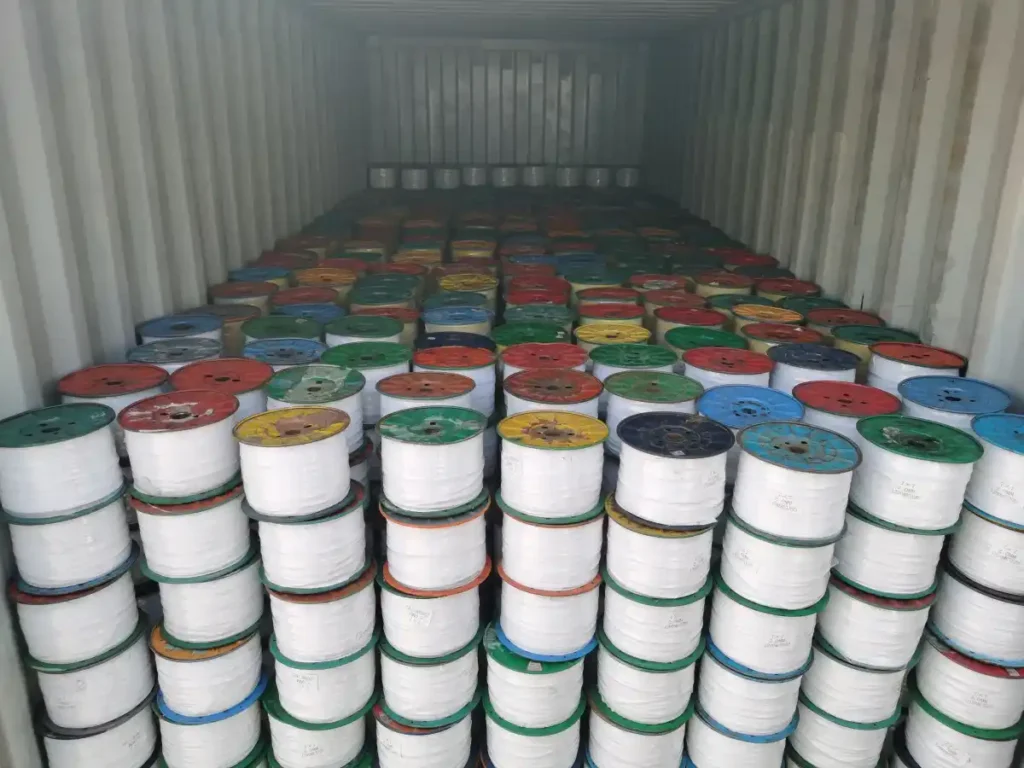
Steel wire rope is heavy cargo. A 20-foot container (20GP) has a maximum payload of roughly 28 metric tons. A 40-foot container has the same weight limit. For small-diameter galvanized wire rope, even 28 tons does not come close to filling a 20GP container’s volume. You will never need a 40-foot container for this product — the weight limit caps you long before the space limit matters.
So packaging does not affect how many tons you can fit in a container. But it does affect two things that hit your bottom line:
First, tare weight. Every spool or reel you ship is part of your 28-ton limit, but it is not wire rope. An iron spool adds weight. A wooden spool adds weight. Coil packaging adds almost nothing. A shipment packed on heavy wooden reels might deliver 300–500 kg less usable wire rope than the same shipment in coils, because that weight went into the packaging, not the product. You paid ocean freight on that packaging weight just the same.
Example: If wooden spool packaging accounts for 5% of the total shipped weight, on a 28-ton shipment, you are paying freight on roughly 1.4 tons of wood — every single order.
Second, unloading at your warehouse. A container of coils requires a forklift and careful handling to avoid tangling. A container of iron-spooled wire rope can be offloaded faster and stacked securely. The labor hours matter if you are receiving containers regularly.
What to ask your supplier: What is the tare weight of the spool or reel per ton of wire rope shipped? How does that compare to coil packaging? Can you help me calculate the net product weight I am actually paying freight on?
4. How much wire rope ends up as scrap at the end of a coil — and can the supplier reduce it?
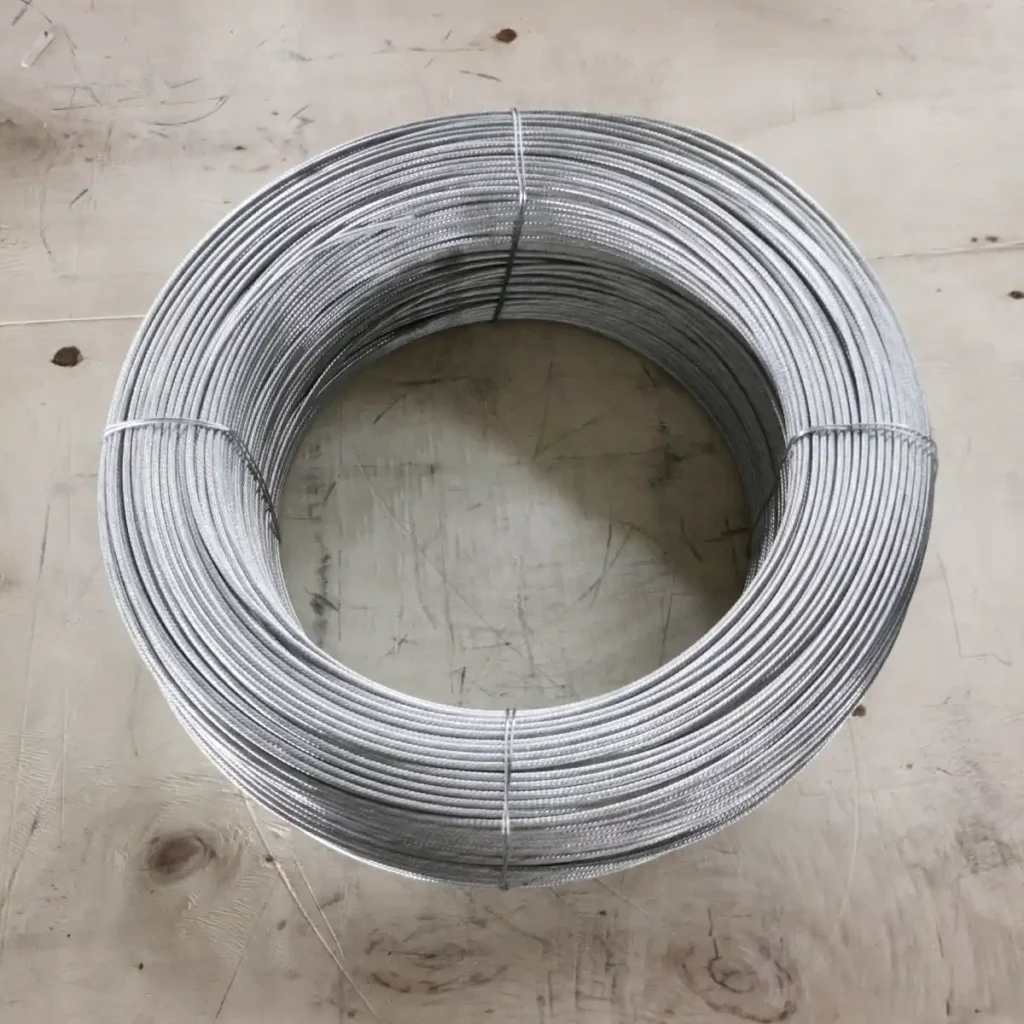
Every packaging format has a tail. The last few meters of wire rope on a spool or coil are often unusable — either because they are secured too tightly to the core, or because the remaining length is too short to feed into your cut-to-length machine.
- Iron spools: The inner end is typically secured through a hole in the spool flange and wound tightly. The last 2–3 meters may be deformed or inaccessible. For thin gauges like 1.5mm, 3 meters per spool adds up fast if you run through dozens of spools per week.
- Coils: The inner and outer tails are tied off. Depending on how the coil is secured, 1–5 meters at each end may be kinked or damaged by the tie point.
A supplier that thinks about your scrap rate will offer solutions: using softer securing methods on the inner tail, adding a few extra meters to compensate for unavoidable scrap, or marking the exact usable length on each packaging unit so you can plan your production runs precisely.
What to ask your supplier: How do you secure the inner and outer ends? What is the typical unusable length per packaging unit? Can you adjust the winding method to minimize scrap on my end?
5. Which packaging protects the wire rope best during long-haul ocean freight?
Your wire rope spends weeks at sea. During that time, it faces humidity, salt air, temperature swings, and physical handling at multiple ports. Packaging is the only thing standing between your product and a rust claim.
- Iron spools provide solid structural protection. The steel flanges prevent crushing and keep layers from shifting. However, bare steel spools can rust. A supplier who uses rust-inhibited or painted spools adds an extra layer of protection.
- Wooden spools absorb impact well but can trap moisture against the wire rope surface if not properly dried or treated. Wood that was not kiln-dried before spool assembly can create a micro-environment of humidity inside the packaging.
- Coils are the most exposed. Without a rigid core or flange, coils rely entirely on external wrapping — VCI (Volatile Corrosion Inhibitor) film, desiccant packs, and heavy-duty plastic sheeting. If the wrapping gets torn during handling, the wire rope is directly exposed.
What to ask your supplier: What anti-corrosion measures do you apply for ocean freight? Do you use VCI film, desiccants, or rust-preventive oil on the spools? Can you show me photos of how a shipment to my region was packaged?
6. Can the supplier customize packaging to fit my specific workflow?
Standard packaging is a starting point, not a solution. Your production line has specific pay-off rack dimensions, specific changeover procedures, and possibly specific end-customer packaging requirements.
A supplier worth keeping can accommodate customizations such as:
- Spool flange diameter matched to your pay-off rack.
- Coil ID and OD sized so the coil sits securely on your payout turntable.
- Winding direction (clockwise or counterclockwise) to match your line’s pay-off orientation.
- Retail packaging — small pre-measured coils with your branded label, ready for your aftermarket customers.
These customizations typically do not add meaningful cost per unit, but they require a supplier willing to adjust their standard process. The willingness itself is a signal: this supplier sees you as a long-term partner, not a one-time transaction.
What to ask your supplier: If I send you the specs of my pay-off rack, can you match the spool dimensions? Can you produce retail-ready small coils with custom labeling? What is the typical lead time for custom packaging?
Quick-Reference Summary: Packaging Types vs. Hidden Costs
| Packaging | Changeover Speed | Scrap Rate | Container Efficiency | Ocean Protection | Customizable |
|---|---|---|---|---|---|
| Iron Spool B60 | Fast | Low (2–3m tail per spool) | Moderate tare weight | Good (rigid structure) | Yes — flange size, height |
| Iron Spool B80 | Fast (fewer changeovers than B60) | Lower (fewer spools = fewer tails) | Moderate tare weight | Good (rigid structure) | Yes — flange size, height |
| Wooden Spool | Fast | Low (2–3m tail) | Higher tare weight (freight on wood) | Moderate (moisture risk) | Limited |
| Coil (Drumless) | Slower | Moderate (1–5m tails) | Lowest tare weight | Depends on wrapping | Yes — ID/OD, direction |
| Retail Pack | N/A | Pre-measured | Moderate | Good | Yes — label, length |
The per-ton price of wire rope is only part of the story. How it arrives, how it feeds into your line, and how much of it ends up on the factory floor instead of in the scrap bin — these are the questions that separate a supplier who ships product from a supplier who understands production. Ask all six.